SynthID at the Art Festival
2026-02-12This post is an addendum to my last article on Google’s SynthID, read it here.
There was one more attack I tried against SynthID, one that’s gaining relevance as human artwork loses provenance.
I printed it.
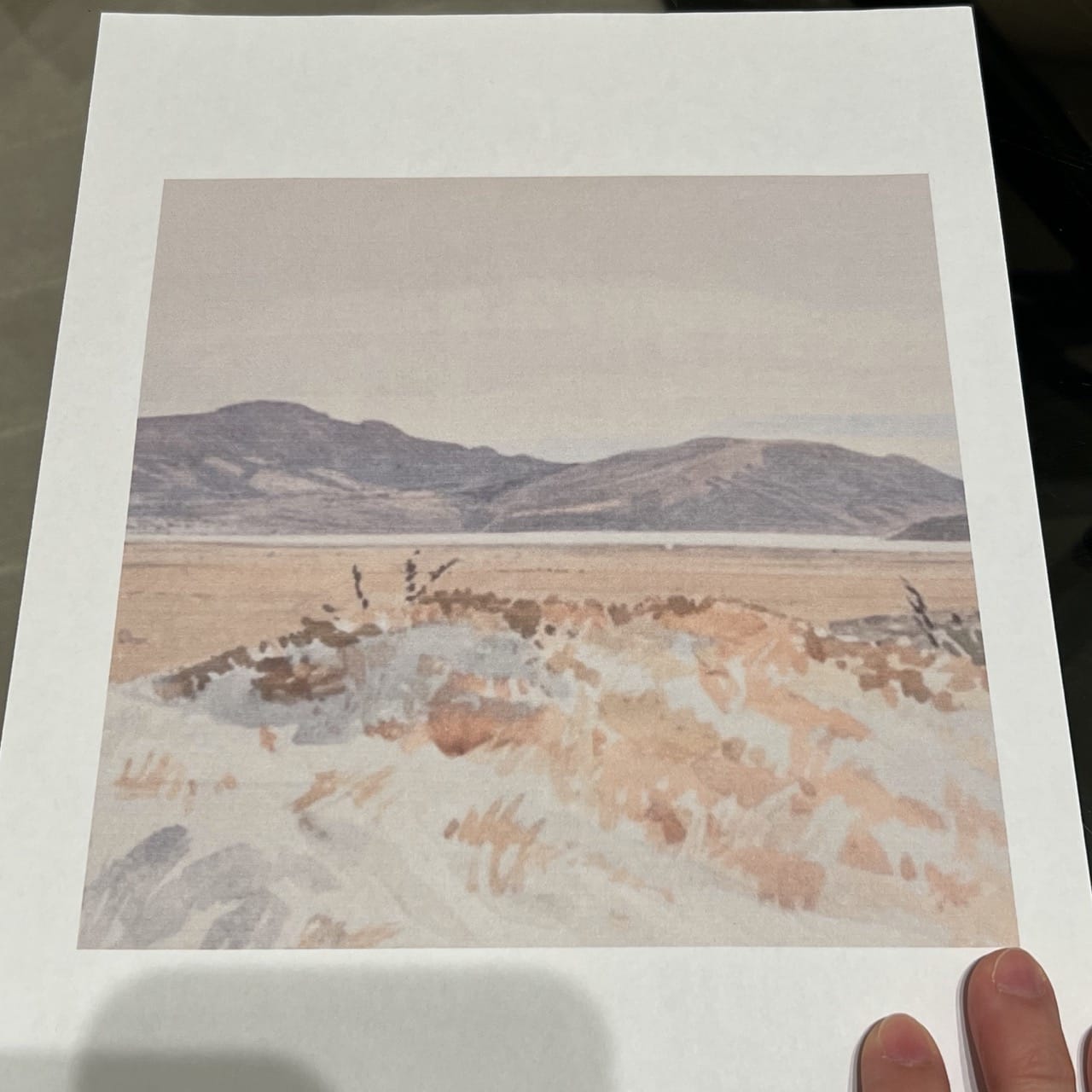
No, it’s not the fanciest paper, in fact, it’s as plain as you can get. The colors were muted, the details muddled, and dynamic range crushed. However, we found that in the last post, such things didn’t matter, so let’s give it a test.
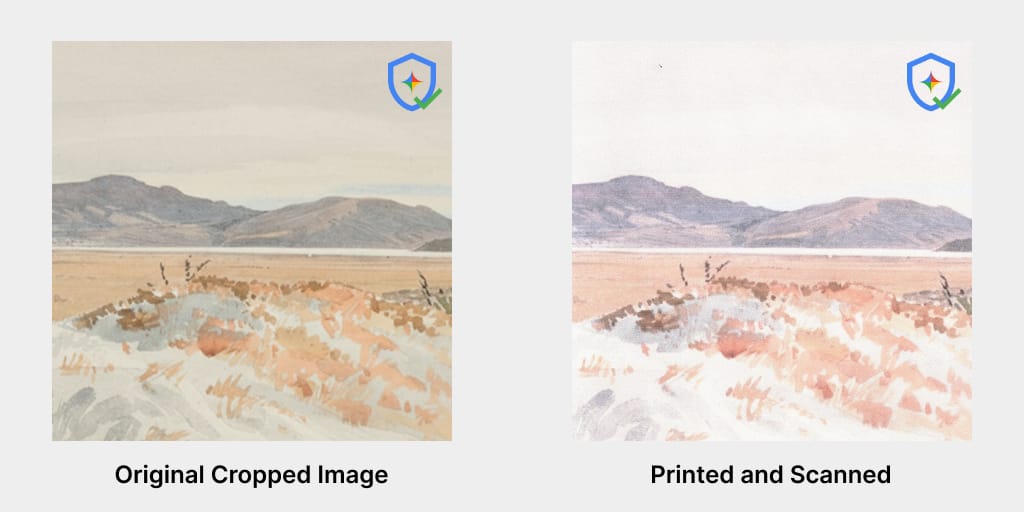
Very impressive! SynthID survived printing and scanning, digital to paper and back. Let’s try something more realistic now.
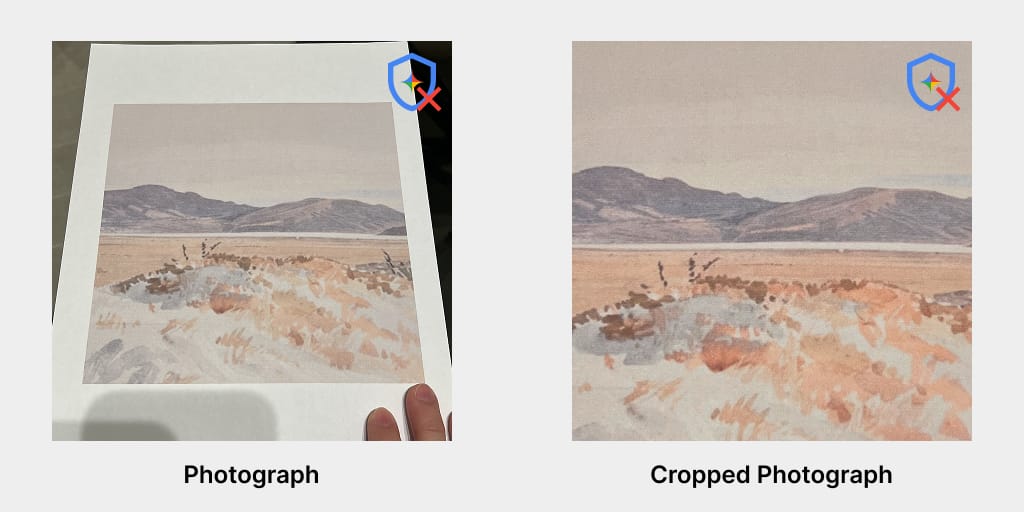
Oof, no dice. Seems something about the off-axis perspective, resolution, or color rendition finally threw it off.
So what does this say? Very little really, this is hardly a comprehensive or rigorous examination of SynthID in the real world. However, it does raise a point about how these SynthID encoder/decoder models were trained, namely, they likely lacked quite a bit of real world data.
SynthID seems designed for a particular threat type: online proliferation. It’s been exposed to and easily handles all manner of cropping, scaling, compression, and filters. Training data for that can be generated quickly and easily, billions at a time. In comparison, what I’ve just done doesn’t scale. Taking photos, even dozens a minute at a myriad of angles, would take years to create a comprehensive dataset, never mind the sheer variety of cameras and environments that exist. As such, I don’t expect Google to tackle this scenario with much enthusiasm, and that is a problem.
Slop at the Faire
Let’s take a quick tangent.
I’ve seen them, I’m sure you have too. They’ve shown up at the local arts and crafts fair, at the board game store, and most recently at the state aquarium gift shop in a pallet-sized bin filled to the brim with plastic trinkets in a “buy by the bag” ploy.

These are articulated 3D printed toys, most commonly dragons, printed in iridescent silk PLA for mass market appeal. Their earliest appearance seems to be mcgybeer’s Articulated Dragon in November 2021, a creative and novel use of additive manufacturing to create print-in-place joints as part of a well-crafted recreation of the eastern mythological figure. Its snake-like movement paid homage to its origin, as did the deer antlers, long whiskers, and regal demeanor. It quickly caught on in the 3D printing world, featuring on reddit, YouTube, and several dedicated sites. What came after was less thoughtful.
These 3D dragons needed no assembly or post-processing, looked good as a sculpture, and made for a genuinely fun toy. They cost less than $1 in filament to make, but could often fetch $10 or more from a curious onlooker or the parent of a rambunctious child. A couple success stories later, they soon became a staple of crafts fairs as people scrambled to start their own “3D printing businesses”. As Bambu Lab hit the market with their near-foolproof X1C multi-color printer, the design space exploded with increasingly colorful plays on the same articulated design.
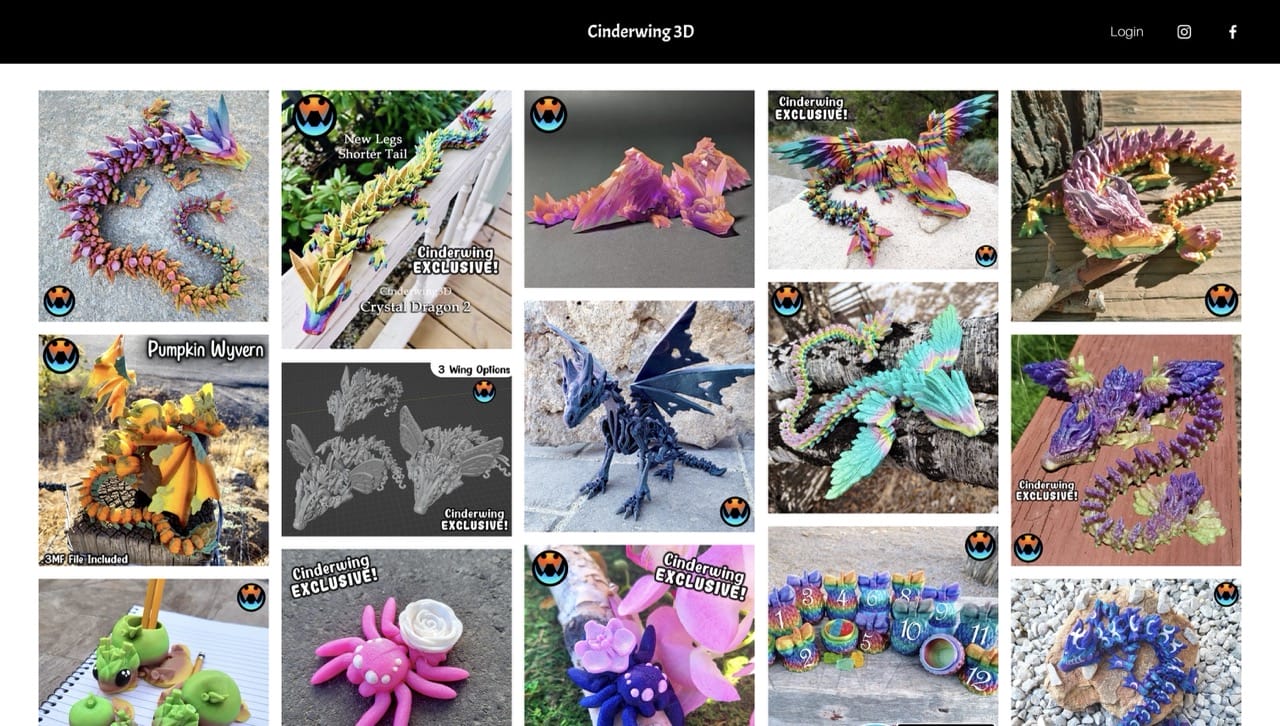
Nowadays, spaces that sell creative goods are awash with mass-produced plastic trinkets, to the dismay of the artists they’re selling alongside. For the family of four who came to check out the night market, it’s often the case that lil’ Timmy clamoring for the colorful dragon toy might use up the thirty bucks that Mom would have otherwise spent on a lovely landscape print. Not that said print wasn’t a mass-producible recreation of an original, but most artists only sell prints of their own work. Many a 3D printing stall owner has never touched Blender or Z-Brush, relying on prolific skilled designers like Cinderwing3D to license out their models for a small fee.
Show me the Incentive
In this world where even art is a commodity, it is obvious to see where this goes. Why spend the extra money on the bloke who took a decade learning to paint a gorgeous landscape, if the stall next door has a canvas almost as visually interesting yet a quarter the price. Prints don’t need to cover a young artist’s already meager living expenses, they only need to offset the booth cost for an aspiring “side hustler”. Printing on canvas isn’t as cheap, but is certainly cheaper than the blank canvas, paints, and enormous time investment required for the real deal. With even a half-decent eye for color, one could even indulge in the time-honored HomeGoods trick of adding some thick swatches of hue-matched paint atop a printed canvas.
There’s quite the incentive to mimic, then undercut, real human artistry in its last true refuge. Already, digital AI art has saturated Fiverr and Etsy, replacing creatives in entry-level commissioned work. Many who’ve spent years refining their craft in Clip Studio Paint or Procreate are now fighting an uphill battle for exposure and income against those whose “art” takes 30 seconds to produce on even an ancient GPU.
The physical space has been comparatively more insulated, partly due to the lack of online anonymity in a space where their customers and competitors might react poorly to their “work”. However, as tech companies vie for the crown of “generated work hardest to distinguish from the real deal”, there’s almost certainly going to be more people willing to take a chance passing off the product of matrix multiplication as the product of their own earned skill.
It’s in this domain that again, SynthID falls short. As an engineer, I completely understand the technical limitations and tradeoffs made in order to define a reasonable scope and deliver an impressive product in a human lifespan. As a member of a society feeling the tangible impacts of “move fast and break things”, I’m much less amused. There’s enough limitations on SynthID that the improved ability to verify provenance doesn’t hold a candle to the growing capacity to create convincing fakes.
In releasing yet another increasingly capable and dangerous generative AI into the hands of the general public, Google justified their destruction of visual evidence as a medium by handing us a proprietary pair of magic glasses.
“Hey, since we’ve removed all the obvious tells of AI work, you should use this instead.”
In fine print, it came with the following caveats: “Only for use with Google products only, only recommended for well-cropped screenshots, only so long as they haven’t been laundered through another AI.”